1. "I got into the programme in a quite an unorthodox way”
“I ended up in this programme in quite an unorthodox way,” he says.
At the time, the whole application landscape felt hypercompetitive — the kind of environment where you’re constantly second-guessing yourself, constantly tweaking things, constantly being told to do more and do better. Piotr admits he was intimidated by it. He cancelled a lot of applications. But despite the frustration, there was one thing he didn't cancel: his idea.
And in a way, that’s the thread running through his story — the applications came and went, but he kept coming back to the same question he genuinely cared about. “At the University of Cambridge, we have a sort of mini-dissertation that we need to write during the penultimate semester,” Piotr explains. “Mine happened to be around one of the topics within the constellation of the Skolem Problem.” He pauses, then tries to put the technical part into plain words. “Basically, the Skolem Problem is decidable for orders up to 4, but only for real algebraic numbers. And I found an idea to extend it to all algebraic numbers.”
And he’s very quick to temper expectations — not in a defensive way, more like someone trying to be honest about what research actually looks like. “It’s not a groundbreaking result,” he says. “It’s not like I solved a famous open problem overnight. But it was really exciting — I had seen something other researchers seemed to have missed.”
And that, for a young researcher, is a powerful moment.
2. “It hit me at 2 a.m.”
Can you describe the moment when you felt this suprising research discovery?“Oh, inspiration strikes at strange times,” Piotr laughs. “That moment almost sounds too good to be true, but it genuinely happened.” “It hit me at 2 a.m. I was lying half-awake, and suddenly a thought clicked into place. It was strange and exciting at the same time — like you’re not fully sure you’re thinking clearly, but you can feel something shift"
Thankfully, he did the sensible thing: he wrote it down immediately.
“I scribbled it on a piece of paper before going to sleep,” he says. “The next morning I woke up, read what I had written, and I fully expected it to be gibberish. Honestly, I didn’t even want it to be true, because I also thought ‘There is no way I didn’t miss something obvious’.”
So he did what researchers do when they don’t trust their own excitement: he tried to break it.
“I kept thinking there must be a mistake somewhere that escaped my radar or I’d missed some obscure paper and my result was already known. I wasn’t sure about it so I emailed it to my supervisor.”
His supervisor suggested to speak to Joël Ouaknine and James Worrell, both pillars in the field. What followed was a chain of back-and-forth emails, probing questions, scepticism at points — the healthy kind that forces you to sharpen the argument.
“They weren’t convinced by my argument at first, but I managed to win them over in the end. Long story short, they told me about the PhD programme and strongly encouraged me to apply.”
“And at that point,” he adds, “I felt almost driven to it. Like, if people at that level liked my ideas and wanted to work with me, I couldn’t just pass up the opportunity.”
Piotr admits he had one very practical worry before signing on: accessibility. “You hear stories about supervisors who are brilliant academically, but impossible to reach because they’re constantly traveling or buried in commitments,” he says. So during the job interview he asked it directly — whether there would be regular opportunities to meet and discuss progress. Joël’s answer didn’t miss a beat. In his usual dry wit, he glanced at his office — all glass walls, completely open — and said, “Well… I can’t hide.” Piotr laughs when he repeats it. “It was funny, but also reassuring. It told me everything I needed to know. And, indeed, there are no walls between us.”
3. “I can’t be happier — personally and professionally”
How do you evaluate your experience within the doctoral programme so far?”“Overall, I can’t be any happier, both personally and professionally,” Piotr says without hesitation.
On the personal side, he highlights something simple but surprisingly important: you don’t just join one environment — you effectively join two.
“At a personal level, I have access to two research groups instead of one,” he says. “That gives you so many opportunities — connections, networking, ample opportunities to meet leading researchers from all over the world… and honestly, there’s a lot of fun in discussing research with different voices and I also enjoy the feeling of wrestling with one idea for a longer time — which is what research is all about after all.”
He talks about the everyday atmosphere: discussions, group activities, the feeling that you’re surrounded by people who enjoy thinking, not just people who are trying to survive deadlines.
“I personally enjoy the stimulating discussions and activities that we do together,” he says.
Then there's another detail that matters for him specifically.
“Given I was raised in the UK, staying at Oxford prevents homesickness,” he explains. “So the programme lets me spend about six months in Germany, which is fair and enjoyable, but it also lets me stay in the UK — so I have time for my partner, family and friends — which is a privilege.”
He is careful to acknowledge that this is partly a personal advantage.
“Living abroad for a number of years is a big commitment,” he says. “In my case, this programme makes it less scary. But it’s a privilege — it does not necessarily apply to people who don’t come from the UK or Germany.”
Even so, he's clear about the upside.
“Living in two different coutries is really enriching. It changes you — in a good way.”
Professionally, he likes that the the two groups don’t feel like separate worlds.
“At a professional level, both groups are closely interlinked,” he says. “But the Max Planck group is much bigger than the one in Oxford, so I get to experience both: what it feels like to be in a large research group and in a smaller one, at the same time.”
4. Two mentoring styles that fit together
What are the differences between both mentoring styles?“The stark difference,” Piotr says, “is that Joël at Max Planck is much more of a strategic thinker.”
“He has an eagle-eye view on the map. He knows where the interesting lines of research are, and he’s constantly facilitating connections with other world-leading researchers. He’s an amazing communicator too, he’s always giving talks and promoting our work. Sometimes I’m impressed by how he can distinguish between topics that look almost identical — like a pixel of a difference — and yet he can explain why one direction is going to matter more than the other.”
“Ben, on the other hand, is more hands-on,” he continues. “He works on the details. He’ll sit with you inside the argument, inside the proof, inside the exact phrasing.”
"So in the end, both approaches are complementary," Piotr says. “One pushes you to aim in the right direction, the other helps you build it properly.”
And he comes back repeatedly, to something that might soud small, but clearly, isn't.
"I should say that both supervisors are super positive and incredibly encouraging," he says.
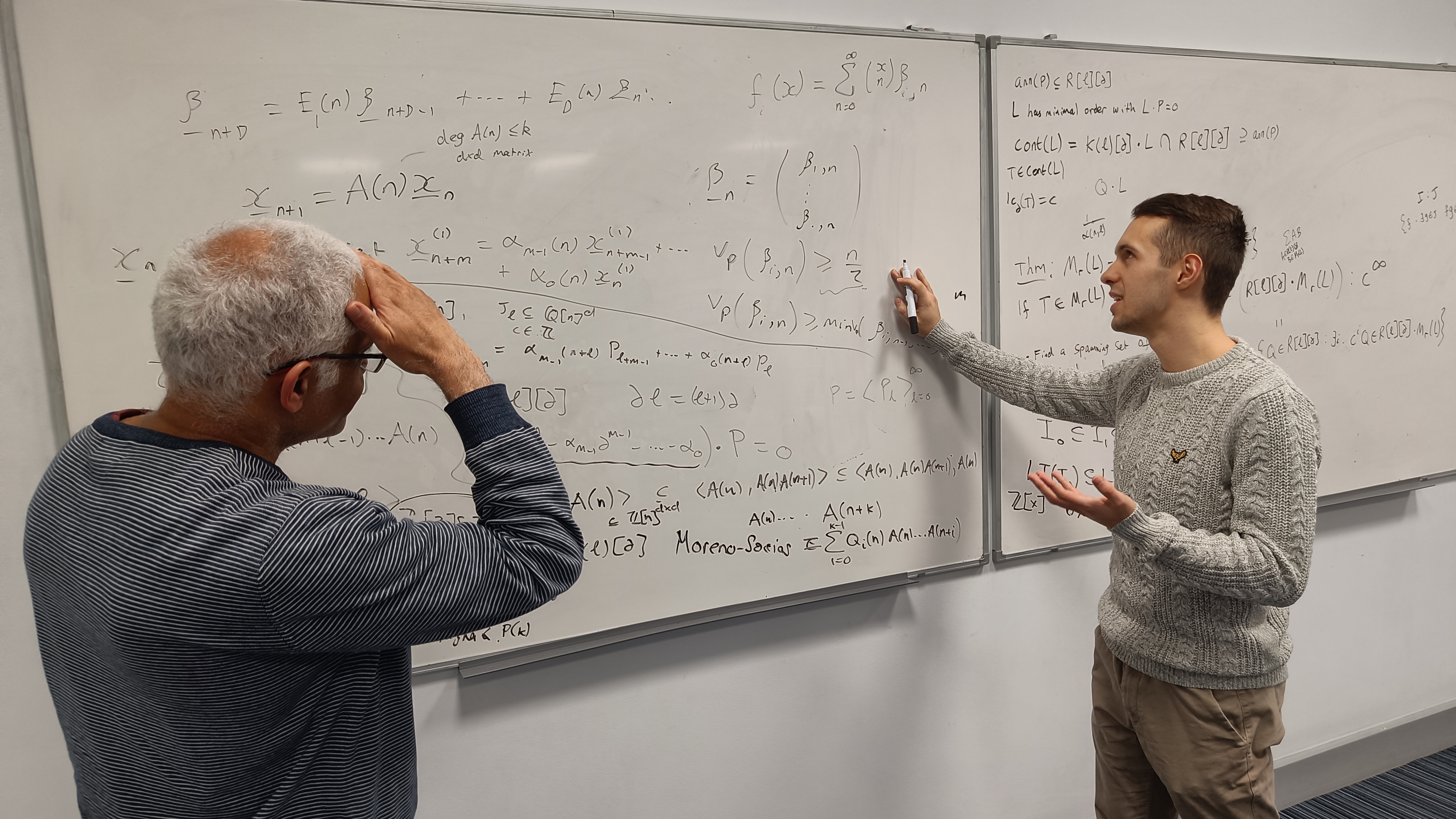
He describes something many PhD students recognise immediately: impostor syndrome, especially at the start.
“Usually PhD freshmen experience impostor syndrome and feel their ideas are a fluke,” he says. “I was asking myself: ‘If I go for a PhD career, will I actually find something interesting? Or will it just be a couple of years with no big outcome?’”
What helped, he says, was the tone set by his mentors.
“Joël’s positivity and enthusiasm changed my perspective and boosted my confidence,” Piotr says. “Even if I felt frustrated at times feeling like my research was progressing slowly, Joël was always super encouraging and made me feel happier with any step I managed to take forward, no matter how small.”
“It’s a minor thing in the grand scheme,” he adds, “but it’s actually huge, because you’re trying to prove yourself. You get space to try things, to be wrong, to learn — without feeling like you’re being judged.”
He also stresses that autonomy doesn't mean being left alone.
“Both supervisors give me a lot of autonomy with my papers,” he says. “But there’s also a lot of guidance — on how to explore ideas, and scrutiny on how to present them.”
“And through their advice on writing and presenting papers,” he smiles, “I’ve picked up a lot of extremely random knowledge. Things you don’t even realise you’re learning until you suddenly use them.”
How do you balance between your work and personal life?“My doctoral work takes most of my time, but I don’t mind it”
He explains why: it’s demanding, but it doesn’t feel like someone is pushing him around.
“My supervisors don’t dump a lot of work on me,” he says. “They never really force me to do anything, but rather propose ideas to investigate — and they trust me to do what I need to do.”
But he’s also honest about the standards.
“That doesn’t mean they don’t have certain expectations though, and I have to take work seriously to meet the bar,” he says. “It takes a certain amount of discipline and time-management, but the most important thing is having enough self-motivation to push yourself.”
Still, even when the workload is heavy, he doesn’t talk about it like a burden.
“Even if my work takes a lot of my time, I don’t mind it, because it simply doesn’t feel like work,” he says. "The progress brings intrinsic happiness and those tiny moments of joy make me feel exactly where I'm supposed to be — like the effort is actually building something, not just consuming time."
5. The Programme is flexible and supportive
What do you appreciate the most in the doctoral programme?“A lot of things!” he says immediately. An then he goes for something that people sometimes hesitate to say out loud.
“Put networking, community support, and research excellence aside,” he says, “I don’t know if this is politically correct, but I appreciate the finances.”
He explains it very plainly: being able to do research without constantly worrying about survival changes everything. “As a PhD researcher in Germany and the UK, you’re considered an employee,” he says, “and you’re paid relatively well for your research, compared to other countries. So it doesn’t feel like I’m being exploited for the efforts I am pushing.” He concludes “It doesn’t feel like I’m wasting my best years and living in poverty, which is what most doctoral students are afraid of.”
He also highlights the practical support for academic travel.
“The programme includes a lot of travel to conferences, and travel is reimbursed.” he says. “There’s a strong support to participate in workshops, conferences, summer schools — academic events in general.”
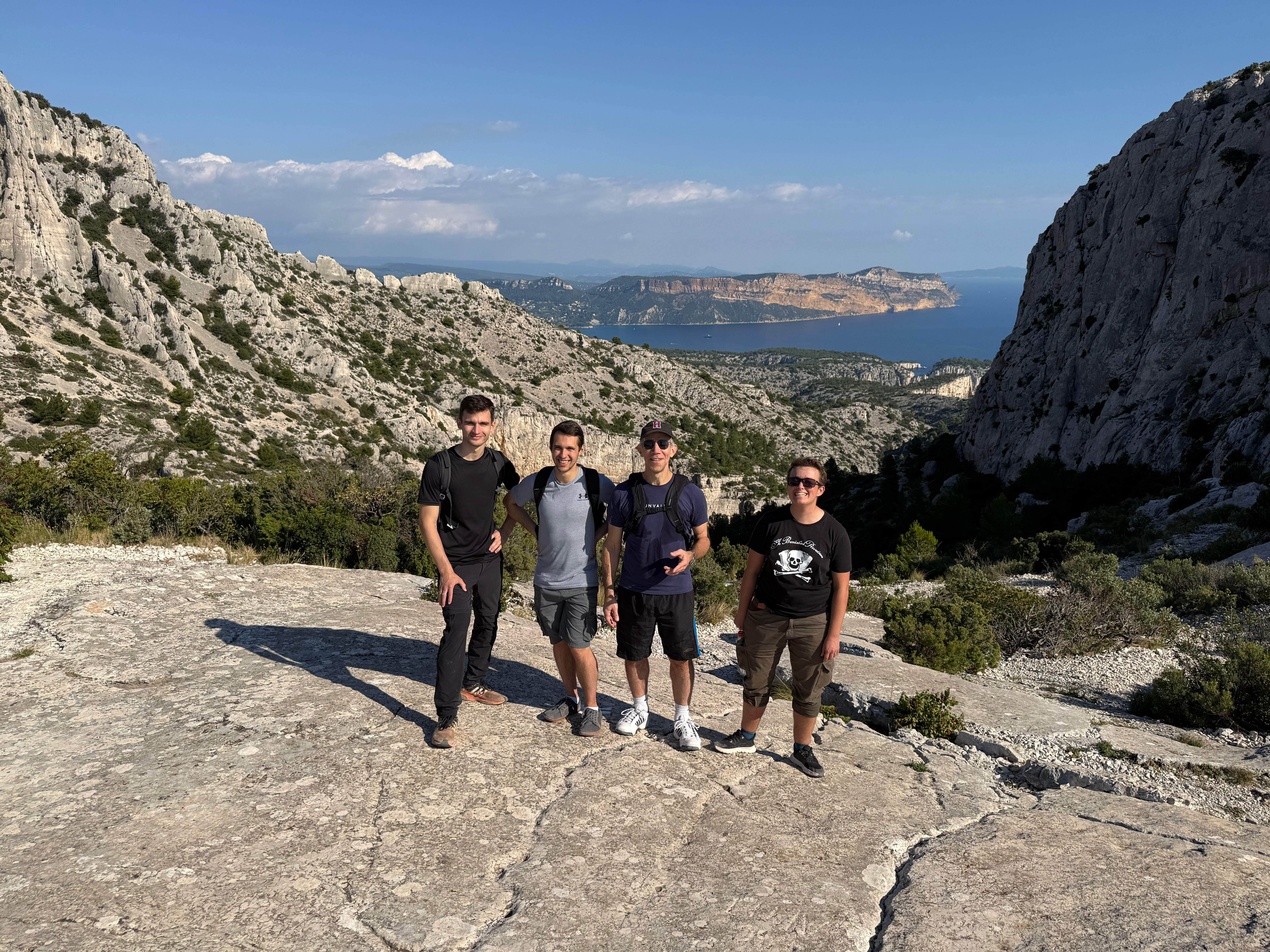
He appreciates flexibility too — not just in abstract way, but in everyday logistics.
“The flexibility of the programme, is something I equally appreciate,” he says. “And in Saarbrücken, the accommodation flexibility is great, thanks to MPI-housing facilities and the International Office.”
Teaching is another piece he points to as “unique feature,” especially because it comes with agency. And finally he describes a quality of research life: “working as a researcher isn’t like a clerk job where you must be on time from 8 to 4,” he says. “When I feel fatigue, it doesn’t make sense to work — so I take a break.”
6. I definitely recommend considering it
Do you recommend this programme? If yes, to whom? And what advice would you give to someone considering it?“I definitely recommend considering it. In my experience, I found it super enjoyable, and it worked well for me in several ways.”
He returns to the programme’s defining features: two institutions, one PhD.
“The access to two institutions simultaneously feels like a professional boost. It really fast-tracked my understanding of academia.”
As for who it suits, he’s crystal clear: “ I recommend it to those who are willing to pursue an academic career and have no problem with travelling,” he says with a light smile. Then he adds the honest warning: there are trade-offs, and people should go with open eyes. “The two-body problem gets harder,” he says. “It is a notorious problem in academia anyway — but you’re probably going to delay living with a partner until the end of the PhD because you’re always on the move. Some things are easier when you’re living in one place. When you’re constantly moving, there can be some small inconveniences like switching phone contracts, gym contracts, finding people to play sports with and so on,” he continues. “There might be extra visa work for some people when moving between two places. It can be tiring. But it’s worth it.”
And his advice is simple, yet deep. It is not a slogan. It is more like a reality check:
“You have to figure out whether academia is the right thing for you,” he says. “And you have to maintain a good relationship with your supervisors — it’s really important both sides communicate well.”
He pauses, then adds something implied throughout his whole story:
“If you’re passionate about your field, if you like the feeling of pushing through confusion until something becomes clear, and if you want to grow in an environment that takes research seriously, then this programme might be for you.”